Things to Do in São Tomé in March
March weather, activities, events & insider tips
March Weather in São Tomé
Long-run averages for March
Making the most of March in São Tomé? Browse tours and activities in São Tomé on GetYourGuide.
Is March Right for You?
Weigh the advantages and considerations before booking
- + São Tomé's rainforest peaks in March. Waterfalls thunder through Obo National Park at full volume, and the cacao canopy grows thick enough to turn equatorial light into deep green. This is when the landscape delivers.
- + March brings the lowest visitor numbers of the year to an already uncrowded island. You will likely be one of a handful of foreign travelers at any given attraction. Beaches that draw modest crowds in the dry season are yours alone.
- + Low-season pricing on accommodation and guided tours makes the island's better lodges more accessible. This includes atmospheric guesthouses converted from renovated colonial roças. Availability is rarely a problem. Operators are more flexible with scheduling and group sizes.
- + The tail end of sea turtle nesting season still brings olive ridley and green turtles to the southern beaches around Praia Jalé. Community-run conservation night watches operate through the month.
- − March is the wettest month on São Tomé's calendar, with 132 mm (5.2 inches) of rainfall falling mostly in intense afternoon storms. Mornings are typically clear and usable. The second half of the day is frequently a washout that pushes you indoors or under cover.
- − Hiking trails in Obo National Park and on the slopes of Pico de São Tomé turn to slick red clay after heavy rain. The sections above 600 metres (1,970 feet) become treacherous. Summit attempts and longer forest routes are weather-dependent and may be cancelled on short notice.
- − Rougher sea conditions limit boat-based excursions. The channel crossing to Ilhéu das Rolas and open-water snorkeling trips are more likely to be cancelled or rescheduled in March than during the calm dry season from June through September.
Settled on March? Compare hotel prices in São Tomé for your dates on Trip.com.
Best Activities in March
Top things to do during your visit
São Tomé in March sits at the hinge of the wet season. Afternoon downpours arrive with theatrical precision. Cloud banks thicken over the Pico de São Tomé massif around two o'clock. Rain hammers the corrugated rooftops of the capital for forty minutes. Then equatorial sun returns so fiercely the puddles on the cobblestones steam. Daytime temperatures hold near 30°C. Nights settle around 22°C, a warmth that never quite releases its grip. Rainfall in March climbs to roughly 132 mm, making it the wettest month of the first half of the year. Noticeably heavier than February's 84 mm. The showers rarely last long enough to cancel a day's plans. The intervals between storms are drenched in light. The island's volcanic greens deepen to a shade that looks almost synthetic. March feels different from the drier months of June through September. That is when the gravana wind cools the coast and the cocoa harvest dominates village life. What you get in March is a particular lushness. Rivers that trickle in August now braid across black-sand beaches. Waterfalls in the interior swell from trickles to roaring white curtains. The roça plantations, the old colonial estates that form the architectural spine of São Tomé, sit wrapped in mist each morning. The scent of fermenting cocoa is sharp and yeasty in the humid air. Fishermen along Praia Rei still push their dugout canoes out before dawn. The slap of oars is audible across flat water. The markets in the capital overflow with jackfruit, breadfruit, and heaps of tiny red peppers that locals fold into calulú stew. For the traveller weighing when to visit, March trades the bone-dry clarity of July for a more intimate island. Fewer visitors. Greener scenery. An equatorial energy that feels unedited. Safety on São Tomé is rarely a concern for visitors. The islands rank among the most peaceful destinations in West Africa. Petty crime stays low even in the capital. The practical challenge is infrastructure. Roads in the interior are unpaved and turn to red clay soup after heavy rain. A four-wheel-drive vehicle or a guide who knows the conditions is not optional. It is the difference between reaching Cascata de São Nicolau and spending three hours stuck in a ditch. Beaches along the northern and southern coasts are volcanic. Expect dark sand that absorbs heat. Bring water shoes for the rocky entries near Lagoa Azul. Swells can surprise even confident swimmers near Praia Piscina.

sipson tours stp
guided_experienceSipson Tours covers São Tomé's greatest hits. The Boca do Inferno blowhole, Roçan Agostinho Neto, and the botanical garden at Jardim. What elevates this guided experience above a standard circuit is the storytelling. Guests report guides who narrate the colonial plantation system, the 1953 Batepá massacre, and the post-independence land reforms with an intimacy that makes the crumbling estate walls and rusted rail tracks feel less like scenery and more like evidence. The route typically threads from the capital south along the coast. It pauses where cocoa drying racks line the road and the sweet, slightly acrid smell of roasting beans drifts from open-sided barracões. Expect a full day on the road. Stops let you taste fresh cocoa pulp straight from the pod. A flavour closer to lychee than chocolate, slippery and tart on the tongue.

South Rote Sao Tome - A trip not to forget
otherThe southern route from the capital to the tip of São Tomé traces one of the most dramatically sculpted coastlines in the Gulf of Guinea. Basalt towers punch out of the jungle canopy. Surf crashes against stacked lava shelves. The road narrows to a single lane cut between walls of banana plants so tall they block the sky. This full-day trip pushes past Angolares, a fishing village founded by shipwrecked enslaved Angolans whose descendants still speak a distinct creole. It continues to the island's far south where the Pico Cão Grande needle, a phonolite plug rising 370 metres from the forest floor, appears suddenly through a gap in the canopy like something from a geological fever dream. The air down here smells of wet earth and wild cinnamon. The only sounds are birdsong and the distant thud of waves on volcanic rock.

Luis Miguel Tour guide-São Tomé
guided_experienceLuis Miguel's guided experience runs more like a conversation with a well-connected São Toméa than a formal tour. He adjusts the itinerary to what interests each group. That might be the colonial architecture of the capital, the cacao-to-bar process at a working plantation, or the medicinal plants that village healers still use in the interior. What comes through in nearly every review is his habit of pulling over at unmarked spots. A roadside fish-smoking operation where women tend racks of flying fish over smouldering coconut husks, the smoke thick and oily. A viewpoint above a bay where humpback whales breach in season. A family compound where palm wine ferments in calabashes hung from raffia palms, the liquid fizzy and faintly sour when you drink it fresh. The pace is unhurried. The vehicle is air-conditioned. The local knowledge is deep enough that repeat visitors to São Tomé still book him.

Tours for cruise ship travelers in São Tomé
cruiseCruise passengers arriving at Ana Chaves Bay face a specific constraint. The tender window is short. The port infrastructure is minimal. São Tomé's interior roads are slow. This tour is built around that arithmetic. It packs the capital's highlights, the pastel-painted colonial centre, the Forte de São Sebastião national museum, the fish market where tuna the size of a child are butchered on concrete slabs in a haze of salt and iron, into a half-day loop that returns to the dock with time to spare. The route typically includes a cocoa plantation visit near Trindade. Guides crack open pods and let passengers taste the mucilaginous white pulp before it becomes the dried bean they recognise. For travellers with only a few hours on São Tomé, this is the most efficient compression of what the island offers. Equatorial heat. Colonial memory. The sharp smell of drying cocoa under a tin roof.
São Tomé: Full-Day Boat Excursion to Rolas Island
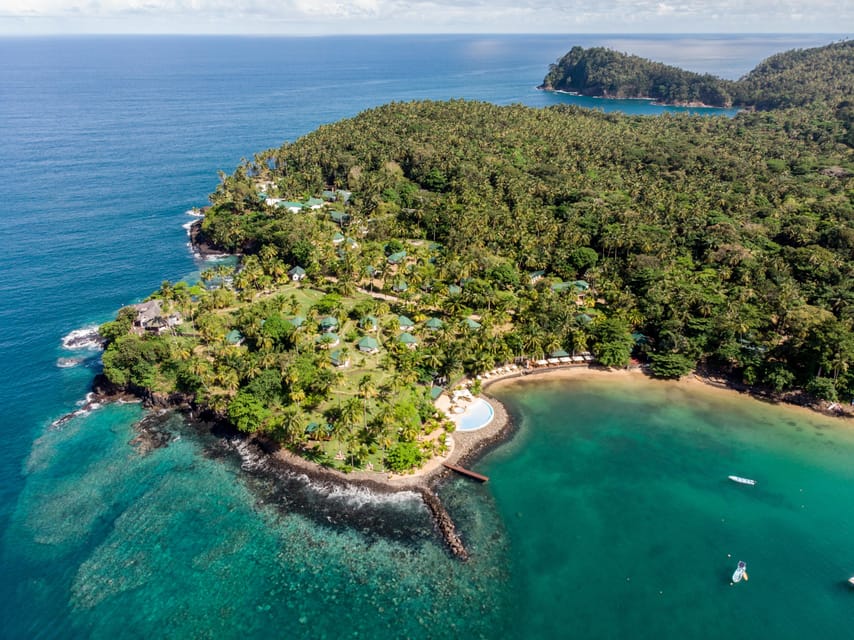
day_tripThe boat ride from São Tomé's southern coast to Ilhéu das Rolas crosses the equator. The crew marks it with a GPS reading and a cheer. It deposits you on a small volcanic island where the forest runs unbroken to the waterline and the snorkelling is the clearest on the archipelago. Underwater, the visibility in the sheltered bays between lava outcrops can reach fifteen metres on a calm day. Parrotfish, moray eels, and coral formations still healthy enough to show full colour. On land, a short trail leads to the Marco do Equador monument. The real draw is the quiet. No cars. No paved roads. Just the hiss of surf on black pebbles and the call of the São Tomé oriole somewhere in the canopy overhead. Lunch is typically grilled fish prepared on the beach. The charcoal smoke mixes with salt air. The flesh is flaky and still tastes of the sea.

Interior Tour
guided_experienceThe interior of São Tomé is where the island's volcanic skeleton shows through. Roads climb into cloud forest where tree ferns arch over the track. Epiphytes hang in curtains from mahogany trunks. The air cools noticeably with every hundred metres of elevation. This guided experience pushes into the highlands around Nova Moca and Bom Sucesso. A botanical garden preserves endemic species found nowhere else on Earth, including several begonia varieties and the island's own giant sunbird. The plantation estates up here, Roça Monte Café and Roça Nova Moca, are some of the most intact on the island. Their stone arches and drying terraces still carry the faint, sweet rot of old cocoa. Morning mist clings to the peaks until midday. When it lifts, the views down to the coast reveal the island's improbable steepness. Green walls dropping into blue ocean with almost no transition.
Packing Checklist
Bookmark this page — your progress is saved between visits
Climate-specific gear, brand recommendations, and what to leave at home.
View São Tomé Packing List →Essential Tips
Insider knowledge and common pitfalls to avoid
Short on time? See day trips around São Tomé on GetYourGuide.
Ready to plan your trip to São Tomé?
Now that you've got the research covered, here's where to go next.
Didn't see anything interesting yet?
Browse Viator's full catalog of tours, day trips, food experiences, and private guides in São Tomé.
See All São Tomé Tours on Viator